Written by Taimur Ansari at BRERPSoft
Last reviewed: October 2026. Facts were checked against the sources listed at the end on 23 October 2026.
Confirm in 5 seconds if your passport or visa type legally requires zero-deductible medical coverage before boarding using our free UAE and GCC visa insurance requirement checker.
Related Resource: Explore our complete breakdown on does Medicare cover international travel.
Related Resource: Explore our complete breakdown on cancel for any reason travel insurance.
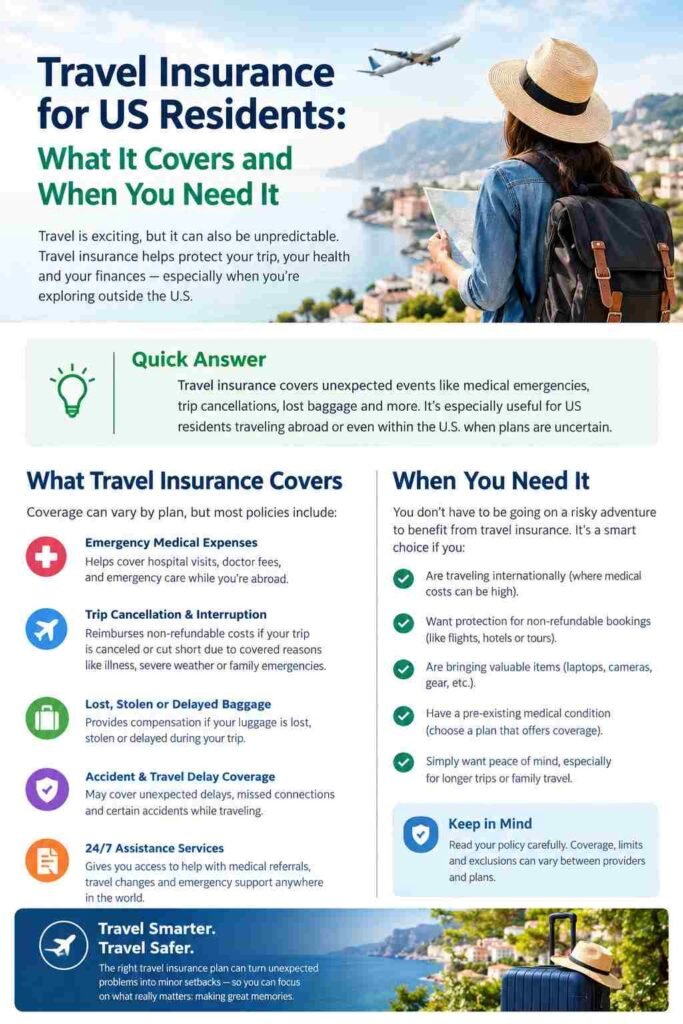
Quick answer: Travel insurance for US residents can refund prepaid trip costs when you cancel for a covered reason, pay for emergency medical care abroad, and fund a medical evacuation. You need it most when your health plan may not pay overseas, as Medicare and Medicaid do not, or when cancelling would cost you money you cannot recover.
Disclaimer: This guide is general information about insurance, not insurance, legal or medical advice. Cover, exclusions, prices and eligibility differ by insurer, plan and state, so read the policy wording before you buy and ask your state department of insurance if something is unclear.
Affiliate disclosure: Links marked as sponsored are affiliate links. If you buy through one, BRERPSoft may earn a commission.
This guide is for people who live in the US and travel outside it, or who prepay for expensive trips inside it. If you live in the UAE and are visiting the United States, read travel insurance for the USA from the UAE instead, because that guide covers the opposite direction.
What travel insurance for US residents actually covers
Travel insurance is a short-term policy bought for a specific trip. It reimburses costs when something the policy lists goes wrong before or during travel. The National Association of Insurance Commissioners (NAIC) describes it as cover for costs such as flights, lodging and medical emergencies when a trip is cancelled or interrupted, and says each policy sets its own limits and its own list of covered and excluded situations (NAIC, June 16, 2026).
In practice a policy is a bundle of separate benefits. One plan may include all of them and another only one, which is why the State Department warns that travel insurance can differ a great deal from one policy to the next (State Department, updated August 11, 2025).
| Type of cover | What it pays for |
|---|---|
| Trip cancellation, interruption and delay | Prepaid trip costs if you cancel, cut the trip short or are delayed for a reason the policy covers |
| Travel medical | Short-term medical care if you get sick or injured while travelling |
| Emergency medical evacuation | Emergency transport to the nearest hospital that can treat you, later transport home if needed, and return of remains if someone dies |
| Accidental death and dismemberment | A payment to your beneficiaries if you die in an accident on the trip, or to you if you lose a limb or your eyesight in one |
| Baggage loss or delay | Lost or delayed bags and personal items |
Source: NAIC, June 16, 2026.
Trip cancellation cover
Trip cancellation cover pays back prepaid trip costs if you have to cancel or cut the trip short for a reason your policy covers. NAIC’s examples include a doctor saying you or a travel companion cannot travel, a family member who is not travelling being hospitalised or dying, severe weather or a carrier problem that disrupts the trip, a natural disaster at home or at the destination, and jury duty.
The word that matters is “covers”. Michigan’s insurance regulator warns that cancellation policies work from a list of named reasons, and that a claim is denied if your reason is not on the list. It also advises finalising your itinerary before you buy, because later changes can affect cover (Michigan DIFS).
Cancel for any reason (CFAR) is a separate add-on. NAIC says it usually has to be bought within a set period after you book, costs more than a standard policy, typically reimburses only part of your expenses, and generally requires you to insure all of your prepaid, non-refundable costs. Compare the cancellation limit with the amount you would actually lose.
Travel medical insurance
Travel medical insurance pays for short-term medical care if you fall ill or are injured while travelling. The CDC describes travel health insurance as a short-term supplemental policy for healthcare costs incurred abroad, sold on its own or bundled with cancellation and evacuation cover (CDC Yellow Book, April 23, 2025). Before you buy, NAIC suggests asking whether the insurer must approve care first and whether pre-existing conditions and dangerous activities are excluded.
A policy does not always spare you from paying up front. The CDC says that even with supplemental cover, care abroad usually means paying by cash or card at the point of service, which can reach thousands of dollars. Some policies arrange direct payment to hospitals, which the State Department and the CDC both treat as a feature worth looking for. Trip cancellation cover, by contrast, usually does not pay for medical costs in other countries.
Emergency medical evacuation
Evacuation cover moves you from a place that cannot treat you to a hospital that can, and later home if needed. The CDC puts the cost of a medical evacuation at about $25,000 for transport within North America and above $250,000 from more distant and remote locations. It describes standalone evacuation cover as relatively inexpensive compared with those bills.
The insurer, not the traveller, decides whether an evacuation happens. The CDC says the traveller is typically hospitalised with several more days of care expected, or needs specialised treatment that the local hospital cannot provide. The State Department strongly recommends evacuation insurance for trips to higher-risk areas or places with limited medical care, and says most health plans do not pay for air ambulance evacuation back to the US (State Department, Medicine and Health).
Baggage and accident benefits
Baggage cover pays for lost or delayed bags and belongings, and accidental death and dismemberment cover pays out after a fatal or serious accident. NAIC notes that most homeowners policies already cover personal property lost or stolen while you travel, so check that policy before paying for extra baggage cover.
Related Guide: Read our detailed analysis on When should I buy travel insurance after booking a trip from the US?.
Do I need travel insurance?
It depends on two things: whether your existing health cover would pay at your destination, and whether you could absorb the loss if you had to cancel. NAIC treats the decision as a set of questions rather than a rule. Would you accept losing the money if you cancelled? Could you pay for rebooking? Is severe weather likely? Are you or a loved one dealing with a health issue? NAIC’s own conclusion is that only you can decide.
When cover is more likely to matter
- You rely on Medicare or Medicaid. The State Department says neither pays for medical care outside the United States, apart from the narrow Medicare exceptions described below.
- Your health plan has not confirmed that it pays for emergency care abroad. The CDC says some US plans do, but the exact cover varies.
- Your destination is higher risk or has limited medical care, which is where the State Department strongly recommends evacuation cover.
- You are taking a cruise. The CDC points out that treatment on board may not be included in the ticket price.
- You have prepaid a lot that you could not recover. NAIC lists the inability to afford rebooking costs as a common reason people buy.
- You are over 65, pregnant, planning an extended stay abroad or living with a pre-existing condition. The CDC says specialised policies can be particularly useful for these travellers, and that people over 75 should start looking early because cover for underlying conditions is harder to obtain.
When you may need less
If your bookings are refundable, your health plan has confirmed overseas emergency cover, and the trip stays inside the US, you may reasonably decide to skip a policy. Credit cards can fill part of the gap: NAIC says some cards include trip cancellation and lost baggage cover, so read the card’s terms. The CDC adds that card benefits vary widely, often require enrolment and a formal claim, and should not be treated as a substitute for a travel disruption, travel health or evacuation policy.
Will my health insurance, Medicare or Medicaid work abroad?
Probably not in full. The US government does not pay medical costs for US citizens abroad, and the State Department says Medicare and Medicaid do not pay for care outside the United States. The table shows where each kind of existing cover stands.
| Existing cover | Outside the US | Source |
|---|---|---|
| Original Medicare | Usually no. Narrow exceptions apply, such as care on a cruise ship in or within 6 hours of a US port. You pay all costs in most cases. | Medicare.gov |
| Medicaid | Does not pay for care outside the US. | State Department |
| Medicare Advantage | Usually does not cover treatment abroad, though some plans include emergency care. | CDC Yellow Book |
| Medigap plans C, D, F, G, M and N | Some emergency care that begins in the first 60 days of foreign travel. A $250 yearly deductible applies, then 80% of billed charges for certain emergency care, up to a $50,000 lifetime maximum. | CDC Yellow Book |
| Employer or individual health plan | Varies. Some cover medical emergencies abroad, but most do not pay for air ambulance evacuation to the US. | State Department |
| Credit card benefits | Vary by card, may need enrolment and a formal claim. Not a substitute for a travel policy. | CDC Yellow Book |
| Homeowners policy | Most cover personal property lost or stolen while travelling. | NAIC |
Medicare.gov counts the 50 states, the District of Columbia, Puerto Rico, the US Virgin Islands, Guam, the Northern Mariana Islands and American Samoa as the US, and everything else as outside it. Beyond the cruise ship case, Medicare may pay for inpatient hospital, doctor and ambulance services in rare cases, for example when a foreign hospital is closer to your home than the nearest US hospital that can treat your condition. Medicare drug plans do not cover prescriptions bought outside the US.
Related Resource: Explore our complete breakdown on the 7-check travel insurance framework.
If your plan does cover some care abroad, the CDC suggests asking the insurer which providers are in network at your destination, whether you need preauthorisation, and how reimbursement works when you pay at the point of service.
How travel insurance works in the US
Insurance regulation in the US is state-based, and NAIC says your state or territory’s insurance department can answer travel insurance questions (NAIC state insurance departments). Rules therefore differ by state. South Dakota’s statute, for example, requires that information on pre-existing condition exclusions is available before you buy, that the documents say whether the cover is primary or secondary to other cover, and that insurers do not sell travel insurance through an opt-out checkbox at trip checkout (SDCL 58-30-212.1). Your own state may set different requirements.
Where you buy a policy
You can buy directly from an insurer, through a third-party comparison site, or from an airline, cruise line, tour operator or travel agent when you book. The CDC notes that many of these suppliers offer cancellation-type cover at booking or build it into the trip price, and that the same cover can also be bought separately. Michigan’s insurance regulator, for example, says you can contact it to find out whether a company, agency or agent is licensed. Your own state department is the place to ask.
When to buy
Buying early helps. NAIC says that waiting until a storm has been named means the policy likely will not cover claims linked to it, and that CFAR cover typically has to be bought within a set period after you book. Pre-existing condition rules are time-based too: the CDC says conditions that needed hospitalisation or direct medical treatment in the 90 days before departure are often excluded. Each policy sets its own look-back and purchase windows, so the wording is what counts.
Primary or secondary cover
Primary cover pays first. Secondary cover pays only what your other insurance does not, so your health plan or another policy is billed before it. The policy documents should say which one applies.
How a claim works
- Get treatment and contact the insurer’s assistance line. The CDC recommends a 24-hour physician-backed support center, which matters most when evacuation is involved.
- Expect to pay the provider yourself at the time of care, then keep itemised bills and receipts.
- Send the documents to the insurer, which decides whether the claim falls within the policy wording.
Documentation matters. In a study of travel health insurance claims cited by the CDC, insurers fully paid only about two thirds of claims, and the main reasons for refusal were pre-existing illness and poor documentation of expenses.
What travel insurance usually does not cover
Every policy is different, but NAIC lists these as the exclusions travellers meet most often:
- pre-existing health conditions
- pandemics
- civil and political unrest at the destination
- pregnancy and childbirth
- activities such as bungee jumping, backcountry skiing and snowboarding
The CDC adds questions worth putting to any insurer: whether mental health emergencies are covered, whether injuries linked to war, terrorism or natural disasters are excluded, and whether cover changes with age.
Pre-existing conditions deserve the most attention. Michigan’s regulator warns that a policy may exclude cancellations caused by one, and the CDC says travellers with underlying conditions should discuss them with the insurer before departure. If you have a medical condition, speak to your doctor before you travel and tell the insurer about it before you buy. For help reading definitions, exclusions and limits, see Travel Insurance Policy Wording Explained.
How much does travel insurance cost?
NAIC says policies usually cost 5% to 10% of the total trip price, with the exact figure depending on the season, destination, your age and other factors. The CDC gives a similar picture for bundled policies: up to 8% of trip cost when cancellation is limited to listed reasons, and up to 15% when you add cancellation for any reason.
As an illustration only, using those percentages and not a quote, a $4,000 trip would cost roughly $200 to $400 to insure at 5% to 10%, and up to $600 with CFAR at 15%. Actual prices depend on the insurer and the policy.
How to compare policies before you buy
The State Department’s checklist is a sound starting point. Check that the policy:
- is valid in the countries you plan to visit and for the length of your trip
- pays for emergency medical care, and says whether it pays the hospital or reimburses you
- covers medical transportation back to the United States
- pays travel and lodging expenses and cash for emergencies
- covers all current medical conditions for you and your family
- covers the activities you plan to do
- comes with a 24-hour help line
Before you pay, check what your health plan, credit card and homeowners policy already cover, and finalise your itinerary so later changes do not undermine the cover. To turn the checklist into a repeatable scoring routine, use The 7-Check Travel Insurance Framework.
Related guides: The 7-Check Travel Insurance Framework, Travel Insurance Policy Wording Explained
Further reading: Does US Health Insurance Cover You Abroad? Employer and ACA Plans Explained.
Further reading: Pre-Existing Condition Waiver: How US Travelers Qualify.
Related Resource: Explore our complete breakdown on (homepage / hub).
Frequently asked questions
Does a credit card give me enough travel cover?
Usually not on its own. The CDC says card benefits vary in who and what they cover, some require enrolment, and nearly all require a formal claim with no guarantee of payment. It says they should not replace a travel disruption, travel health or evacuation policy, and NAIC suggests checking your card’s terms to see whether what it offers is enough for you.
Can I buy travel insurance after I have booked the trip?
Often, but timing changes what you get. NAIC says CFAR cover typically has to be bought within a set period after booking, and that a policy bought after a storm has been named likely will not cover claims linked to it. Check each policy’s purchase windows before you pay.
Will my travel insurer pay the hospital directly?
Sometimes. The CDC says that even with a supplemental policy, care abroad usually requires payment by cash or card at the point of service, and it lists direct-payment arrangements with hospitals as a feature to look for. The State Department also says some policies pay hospitals directly, so ask before you buy.
What if I cannot pay for emergency care abroad?
The State Department may offer limited emergency medical assistance loans to US citizens who cannot pay at the point of service and cannot transfer funds from the US. The CDC says the loan must be repaid and that, in most cases, the Department limits your passport and will not issue a new one until it is paid in full. Contact the nearest US embassy or consulate for eligibility.
Who decides whether I get evacuated?
The insurer does. The CDC says the decision is at the insurance company’s discretion rather than at the traveller’s request, and that it typically requires hospitalisation with several more days of care expected or treatment the local hospital cannot provide. Ask how the policy defines an adequate facility before you buy.
Sources & references
- U.S. Department of State, Travel Insurance, last updated August 11, 2025. Accessed October 23, 2026.
- U.S. Department of State, Medicine and Health. Accessed October 23, 2026.
- CDC Yellow Book 2026, Travel Insurance, Travel Health Insurance, and Medical Evacuation Insurance, April 23, 2025. Accessed October 23, 2026.
- NAIC, Should I Get Travel Insurance?, June 16, 2026. Accessed October 23, 2026.
- NAIC, State Insurance Departments. Accessed October 23, 2026.
- Medicare.gov, Travel outside the U.S.. Accessed October 23, 2026.
- Michigan Department of Insurance and Financial Services, Travel Insurance. Accessed October 23, 2026.
- South Dakota Codified Laws 58-30-212.1, Required provisions and disclosures for travel insurance. Accessed October 23, 2026.