Related Resource: Explore our complete breakdown on how to file a travel insurance claim in the UAE.
Related Resource: Explore our complete breakdown on cheap travel insurance UAE.
Avoid airport boarding denials and VFS Global rejections by checking exact minimum medical coverage limits using our UAE travel insurance compliance checker.
Travel Insurance Guide
Understand missed connecting flight insurance, eligible expenses, policy exclusions, airline rebooking, and the documents needed to file a claim after a travel disruption.
Related Resource: Explore our complete breakdown on travel insurance for UAE residents.
Related Resource: Explore our complete breakdown on best travel insurance UAE.
Category: Travel Insurance · Reading time: approximately 10–12 minutes
Quick Answer: Does Travel Insurance Cover a Missed Connection?
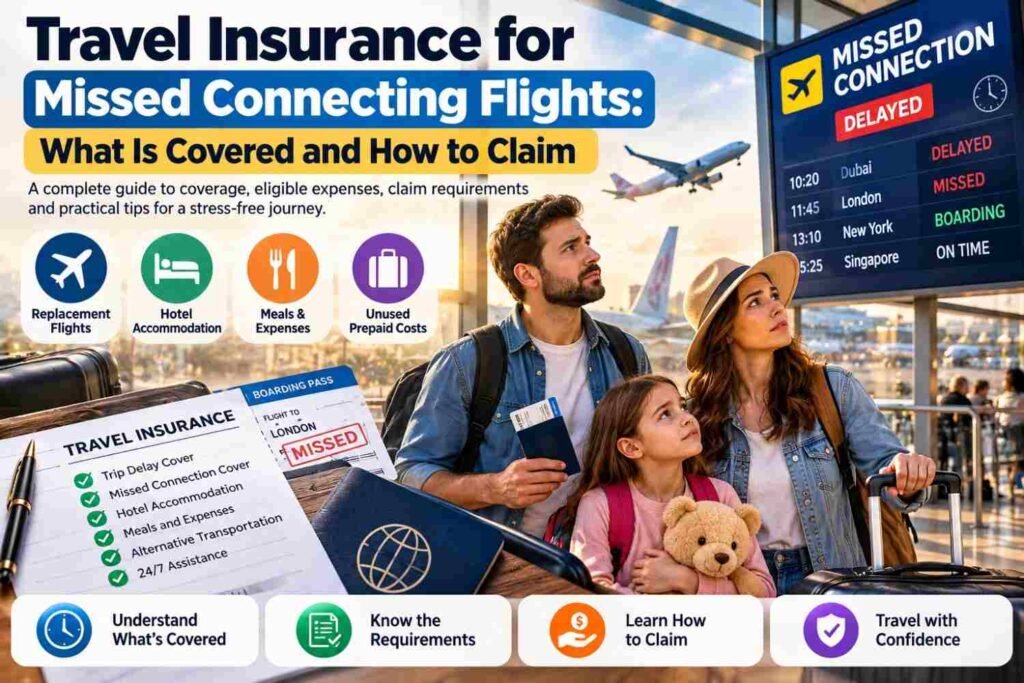
Travel insurance may cover a missed connecting flight when a qualifying delay or other covered event prevents you from boarding your scheduled onward transport. Depending on the policy, eligible benefits may include additional transportation, reasonable accommodation, meals, or certain unused prepaid trip costs. Coverage depends on the reason for the disruption, minimum connection-time rules, benefit limits, and claim evidence. Before purchasing a plan, check its specific missed connection benefit rather than relying on a general travel-delay description.
Key Takeaways
- Missed connection coverage and flight delay coverage are related but different insurance benefits.
- A covered carrier delay or severe weather may qualify, depending on the policy wording.
- Some policies require a minimum connection interval; short layovers may be excluded.
- Separately booked flights and self-transfer itineraries need special attention before purchase.
- Eligible expenses may include replacement transportation and certain unused prepaid arrangements, subject to the policy.
- Keep the original itinerary, airline disruption confirmation, replacement tickets, receipts, and claim correspondence.
- Check airline assistance and insurance coverage separately because they are not the same entitlement.
1. What Is a Missed Connection in Travel Insurance?
A missed connection occurs when a traveller cannot board scheduled onward transport after arriving too late or being prevented from reaching the departure point on time. A delayed incoming flight is one possible cause, but the outcome depends on the itinerary, the reason for the delay, and the next departure’s boarding deadline.
Travel insurance missed connection coverage is a benefit that may reimburse specified additional expenses when a covered event causes you to miss a scheduled part of your journey. It is not a guarantee that an insurer will pay for every missed flight, replacement ticket, hotel, or meal.
For example, imagine your first flight is scheduled to arrive at 10:00 a.m., but it arrives at noon. Your connecting flight departed at 11:15 a.m. If the incoming delay caused you to miss the onward flight, you may need rebooking or an overnight stay. Your airline’s response and your insurance eligibility must then be assessed separately.
The U.S. Department of Transportation advises travellers to consider connection time and the possibility of delays when choosing an itinerary. Its guidance is useful for trip planning, but passenger rights vary by route, carrier, and jurisdiction. Read the U.S. Department of Transportation’s Fly Rights guidance for the U.S. context.
2. What Does Missed Connection Insurance Cover?
Missed connection insurance may help with eligible extra costs required to continue an insured journey after a qualifying disruption. The exact benefit may reimburse actual expenses up to a limit or operate under another structure specified in the policy schedule.
Additional transportation and replacement flights
Some policies reimburse eligible transportation expenses needed to rejoin a trip after a covered missed departure. This may include a replacement flight or another permitted transport option. Check whether the policy requires prior approval, limits the fare class, or caps the total benefit. Do not assume an upgrade or the most expensive available ticket will qualify.
Hotel accommodation and meals
Depending on the plan, an overnight disruption may lead to eligible accommodation or meal expenses. Policies can set daily limits, total benefit limits, waiting periods, or approval requirements. Retain itemised receipts and confirm whether the airline or insurer’s assistance service can arrange accommodation directly.
Unused prepaid travel arrangements
Some policies may reimburse certain unused, non-refundable prepaid travel costs that are lost because of a covered disruption. These might include an insured tour, transfer, cruise departure, or another trip component. The policy must specifically cover the loss, and refunds or credits from the travel provider may affect the claim amount.
Assistance with travel arrangements
Insurers may provide a travel assistance service to help explain options or arrange alternative transportation. Assistance is not the same as automatic reimbursement. Ask the insurer what it can arrange and whether it must authorise any expense before you book it yourself.
| Expense | Possible benefit | What to verify |
|---|---|---|
| Replacement transport | Eligible costs to rejoin the trip | Maximum benefit, approval, fare restrictions |
| Hotel accommodation | Reasonable eligible overnight costs | Nightly limit, receipts, prior approval |
| Meals | Eligible meals or a specified allowance | Daily cap, waiting period, exclusions |
| Unused prepaid trip costs | Some covered non-refundable expenses | Covered reasons and provider refunds |
Provider examples help illustrate why policy wording matters. Travel Guard’s missed connection guidance describes eligible additional transportation costs and certain missed trip costs. AXA’s missed connection guidance discusses transportation, meals, accommodation, and minimum-delay conditions. These descriptions do not establish the terms of other providers’ plans.
3. What Is Not Covered by Missed Connection Insurance?
A claim may be declined when the missed departure does not meet the policy’s covered-event definition or the traveller fails an eligibility condition. The full exclusions section is essential because benefits can differ considerably between plans.
- Arriving late through your own actions: Oversleeping, leaving too late, or missing boarding after arriving at the airport may not qualify.
- Insufficient connection time: Some policies specify a minimum scheduled interval between flights. A shorter layover can make the benefit ineligible.
- Separate-ticket restrictions: A plan may exclude or limit self-transfer itineraries or separately booked flights.
- Uncovered disruption causes: Weather, carrier delays, strikes, technical issues, and cancellations are not necessarily treated the same way by every policy.
- Known events or timing restrictions: The policy may exclude certain events known before purchase or impose purchase deadlines.
- Expenses above the permitted amount: Luxury accommodation, upgrades, or unusually expensive alternatives may exceed the policy limit or fail its reasonableness conditions.
- Missing evidence: Insufficient proof of the disruption or expenses can delay assessment or prevent the insurer from establishing eligibility.
- Duplicate reimbursement: Airline refunds, credits, or payments from another provider may affect the amount recoverable.
These are common conditions to investigate, not a universal exclusion list. For example, Travel Guard states that its missed connection benefit has connection-time restrictions in its published guidance. The applicable policy and schedule should always be checked for the traveller’s actual plan.
4. Flight Delay vs Missed Connection Coverage
Flight delay coverage and missed connection coverage are related, but they do not necessarily pay for the same event. A travel delay benefit may respond after a specified waiting period even when the traveller ultimately catches the onward flight. Missed connection coverage focuses on a qualifying disruption that causes the traveller to miss a scheduled departure.
| Feature | Flight delay | Missed connection |
|---|---|---|
| Main trigger | A covered delay meets the policy threshold | A qualifying disruption causes a missed departure |
| Must you miss the next flight? | Not necessarily | Usually, under the policy definition |
| Potential payment | Specified allowance or eligible delay expenses | Eligible costs to continue or rejoin the trip |
| Key conditions | Covered cause and waiting period | Covered cause, itinerary and connection rules |
Consider a traveller whose incoming flight is delayed for four hours, but the connecting flight is delayed too, allowing the traveller to board. The trip delay benefit may be relevant if the policy’s conditions are met, but the traveller has not necessarily experienced a missed connection. If the onward flight departs before the traveller arrives, the missed connection benefit may become relevant.
AXA explains the distinction between missed connection and trip delay in its missed connection benefit guide. The actual terms of a purchased plan take precedence over a general explanation.
5. Same Ticket vs Separate Tickets: What Changes?
The ticket structure can affect rebooking options and insurance eligibility. A protected connection booked as part of one itinerary may be handled differently from a self-transfer that requires the traveller to check in again for an independently purchased flight.
Flights booked on one ticket
When connecting segments are issued under one ticket, the airline may have a process for rebooking passengers after a qualifying disruption. However, the exact assistance depends on the airline’s conditions, route, operating carriers, and applicable passenger rights. Do not assume that every one-ticket itinerary has identical rules.
Flights booked separately
If you purchase two flights independently, the second carrier may treat you as a no-show if you miss its check-in or boarding deadline. You might need to pay for a replacement ticket. Some insurers restrict or exclude separately booked connections, so confirm eligibility before buying a policy.
Self-transfer and airport changes
A self-transfer may require baggage collection, immigration, security screening, a terminal change, or transport between airports. Each step increases the time needed to reach the next departure. Check whether your plan covers self-transfer connections and whether its minimum connection interval applies to your exact itinerary.
Decision rule: Before booking separate tickets, ask the insurer to confirm whether the itinerary qualifies, what minimum transfer time applies, and whether additional transport costs can be reimbursed after a covered disruption. Save the response.
6. Airline Responsibility vs Travel Insurance
Airline assistance and travel insurance are separate routes to resolving a missed connection. The airline may offer rebooking or other assistance under its conditions and applicable law, while an insurer assesses eligible expenses under the purchased policy. One does not automatically guarantee the other.
- Contact the airline: Ask about rebooking, alternative flights, and available meals or accommodation.
- Ask for written confirmation: Obtain the disruption reason and flight timing details where available.
- Contact the insurer: Check whether the event qualifies and whether prior approval is needed.
- Keep a record of assistance: Document any rebooking, refund, credit, hotel, or meal provided by the airline.
- Check local passenger rights: Rules differ by country, route and circumstances.
For U.S. travellers, the U.S. Department of Transportation’s refund guidance explains certain refund rights when a flight is cancelled or significantly changed and the passenger chooses not to travel or accept alternatives. This is not a universal rule for every international itinerary, and it should not be confused with an insurance reimbursement.
BRERPSoft readers can also review our guides on understanding travel insurance policy wording and the 7-check travel insurance framework before comparing coverage terms.
7. Missed Connection Claim Requirements: Documents to Keep
To assess a missed connection claim, an insurer generally needs evidence of the insured journey, the disruption, the resulting missed departure, and the expenses being claimed. The exact list varies by insurer and policy, so use the insurer’s own claim checklist as the final authority.
| Document | Purpose |
|---|---|
| Policy certificate and schedule | Identifies the insured person, policy dates and applicable benefits. |
| Original itinerary and ticket confirmation | Establishes the planned flights and connection interval. |
| Boarding passes and flight records | Supports evidence of the affected journey. |
| Airline delay or cancellation confirmation | Helps establish the disruption and its timing. |
| Replacement ticket and boarding pass | Shows how you continued the journey. |
| Itemised receipts and proof of payment | Supports eligible transport, accommodation and meal expenses. |
| Refund, credit and rebooking records | Shows what the airline or another party has already provided. |
| Claim form and correspondence | Provides the details needed for claim assessment. |
Travel Guard’s required claim documents guidance lists supporting records and proof of payment for relevant claims. Its documentation requirements are provider-specific; another insurer may request different forms or evidence.
Related Resource: Explore our complete breakdown on essential travel insurance coverages.
8. How to File a Travel Insurance Missed Connection Claim
Step 1: Speak to the airline
Go to the transfer desk or contact customer support as soon as you know you will miss your connection. Ask about rebooking, available alternatives, and any assistance you may be entitled to. Save the airline’s response and any disruption notice.
Step 2: Contact the insurer’s assistance service
Use the contact information in your policy documents. Explain the disruption, your itinerary, and the airline’s proposed solution. Ask whether the policy covers the event and whether you need authorisation before purchasing a new ticket or hotel room.
Step 3: Obtain written disruption evidence
Request a written record of the incoming flight’s delay or cancellation, its timing, and the reason if the airline can provide it. Keep the original booking confirmation and any revised itinerary.
Step 4: Make reasonable alternative arrangements
Follow the airline’s instructions and the insurer’s approval process. If an urgent purchase is unavoidable, keep the receipt and explain why the expense was necessary. Do not assume that every self-booked replacement will be reimbursed.
Step 5: Organise your evidence
Create a simple timeline showing the scheduled arrival, actual arrival, onward departure, when you learned of the disruption, and what additional costs followed. Include airline correspondence and proof of payment.
Step 6: Submit the claim on time
Use the insurer’s official claim portal or required submission method. Follow the policy deadline and respond promptly if further documents are requested. Save the claim reference number and a copy of everything submitted.
Step 7: Review the decision
If the claim is declined or reduced, request the reason and relevant policy clause in writing. Compare the decision with your evidence and follow the insurer’s formal complaint or appeal process if appropriate.
9. Practical Examples: When Might a Claim Qualify?
The scenarios below are illustrative examples, not promises of coverage or quotations from an insurer. Actual eligibility depends on the policy and the facts of the disruption.
Example A: A carrier delay causes an overnight missed connection
Your incoming flight is delayed, you miss the onward flight, and the airline rebooks you for the following morning. You pay for a hotel and meals.
What to check: Whether the cause qualifies, whether the itinerary meets the minimum connection rule, and whether accommodation and meals fall within the benefit. Retain the original itinerary, disruption confirmation and receipts.
Example B: Separate tickets and a missed check-in deadline
You book two flights independently. The first is delayed and you miss the second carrier’s check-in deadline, requiring a replacement ticket.
What to check: Whether separately booked connections are covered and whether the policy imposes transfer-time requirements. The second airline’s ticket conditions also matter.
Example C: You arrive at the gate too late
Your flight arrives on time, but you spend too long shopping and miss boarding for the next flight.
What to check: This is generally unlikely to meet a benefit requiring a covered carrier delay or another specified event. Do not assume a missed flight alone creates an insured claim.
Example D: The airline rebooks you without a fee
The airline places you on a later flight without charging for the replacement ticket, but you incur a hotel or local transport cost.
What to check: Whether the remaining expense qualifies under the policy and whether the airline should provide assistance. Disclose all rebooking, refunds, credits and other assistance to the insurer.
10. How to Compare Travel Insurance Policies for Missed Connections
The most useful policy is one whose written terms match your itinerary and potential losses. Do not choose a plan based only on the words “missed connection” appearing on a marketing page.
- Confirm the benefit: Locate the missed connection section and distinguish it from general travel delay coverage.
- Check covered causes: Identify which carrier delays, weather events or other disruptions qualify.
- Review connection time: Compare the policy’s minimum interval with your planned layover.
- Confirm ticket eligibility: Ask whether separate tickets, self-transfers and airport changes are included.
- Compare limits: Review per-person and per-event caps, deductibles, daily limits and covered expense categories.
- Check authorisation rules: Confirm whether you must call the assistance service before making alternative arrangements.
- Review claim evidence: Understand which airline records, receipts and forms are required.
- Read the complete wording: Use the policy document and schedule of benefits rather than relying on a summary alone.
| Comparison field | Plan A | Plan B |
|---|---|---|
| Missed connection benefit | Verify policy wording | Verify policy wording |
| Covered causes | Record eligible events | Record eligible events |
| Minimum connection interval | Check the exact requirement | Check the exact requirement |
| Separate tickets covered? | Confirm in writing | Confirm in writing |
| Benefit limit and deductible | Record actual amounts | Record actual amounts |
| Claim requirements | Check official checklist | Check official checklist |
Use this worksheet to compare actual plans before purchase. Do not fill in limits or mark benefits as included until the applicable policy wording has been checked.
For further reading, see BRERPSoft’s guides to travel insurance for Saudi Arabia, Saudi Arabia travel insurance costs, comparing travel insurance for Saudi Arabia, and UAE travel insurance costs. These destination pages address related insurance questions; destination coverage alone does not prove that a missed connection is covered.
If the article includes affiliate links to insurance products, disclose the commercial relationship clearly near the relevant links. Compare plans using verified terms and explain that the final decision depends on each traveller’s itinerary, residence, destination and policy eligibility.
11. Frequently Asked Questions
Does travel insurance cover a missed connecting flight?
It may cover eligible additional expenses if a covered disruption causes you to miss the connection. The policy may impose minimum connection times, covered-cause requirements, benefit limits and exclusions. Check the full policy wording before relying on this benefit.
What does missed connection insurance usually cover?
Depending on the policy, benefits may include eligible replacement transportation, accommodation, meals, or certain unused prepaid trip expenses. The covered event, expense limits and claim requirements determine what may be reimbursed.
What is the difference between flight delay and missed connection insurance?
Flight delay coverage may apply after a qualifying waiting period even if you make your connection. Missed connection coverage focuses on a qualifying disruption that causes you to miss scheduled onward transport. A policy may include both benefits, but their terms differ.
Will travel insurance cover missed connections on separate tickets?
Not always. Some policies restrict or exclude separately booked flights and self-transfer itineraries. Confirm the insurer’s eligibility rules for your exact itinerary before purchasing cover.
Can I claim hotel expenses after missing a connection?
You may be able to claim eligible accommodation expenses if the policy covers the disruption and includes that benefit. Limits, approval requirements, airline assistance and receipts can affect eligibility.
What documents are needed for a missed connection claim?
Common documents include the insurance certificate, original itinerary, boarding passes, airline delay or cancellation confirmation, replacement ticket, receipts, and claim form. The insurer may request further evidence depending on the circumstances.
Should I contact the airline or insurer first?
Contact the airline promptly to ask about rebooking and assistance, then contact the insurer’s assistance service before incurring substantial extra expenses whenever practical. Follow any prior-approval requirements in your policy.
Can I claim if the airline has already rebooked me?
Possibly. Other eligible expenses may still be considered, but costs already paid or provided by the airline may affect the claim. Disclose any refunds, credits, rebooking or assistance received.
How long do I have to file a missed connection claim?
The deadline depends on the policy and insurer. Check the claims section of your policy documents, submit the claim promptly and keep proof of submission.
Final Word: Choose Coverage That Matches Your Itinerary
Travel insurance for missed connections can help protect against certain additional expenses, but coverage is never determined by the benefit name alone. Review the covered causes, minimum connection interval, separate-ticket restrictions, benefit limits and claim process before purchasing a plan. If a connection is missed, contact the airline and insurer promptly, retain the evidence, and submit only expenses supported by the policy. A clear understanding of the contract is more useful than assuming every travel disruption will be reimbursed.