Check official inbound and outbound travel insurance mandates by destination, visa category, and residency status using our mandatory UAE visa insurance eligibility tool.
Related Resource: Explore our complete breakdown on travel insurance for UAE residents.
Related Resource: Explore our complete breakdown on best travel insurance UAE.
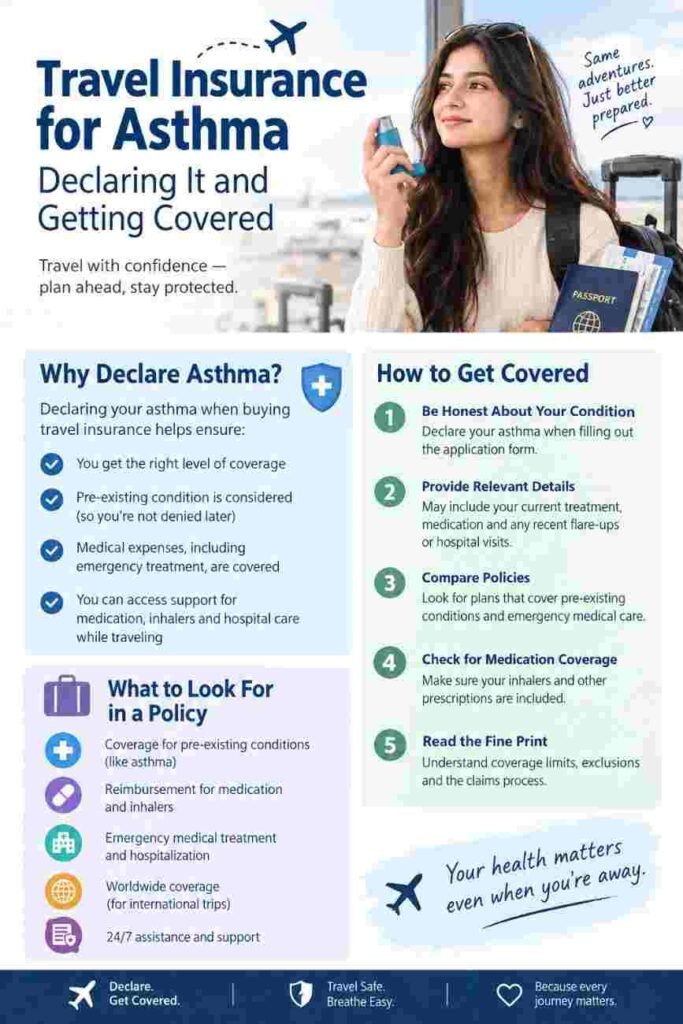
If you live in the UAE and manage asthma, you can still travel confidently — you just need a policy that recognises it as a pre-existing conditions travel insurance[A] matter. This guide explains how to declare asthma, what UAE insurers typically cover and exclude, how medical screening works, and how to protect inhalers, nebulisers, and other devices while you’re away. It’s part of our medical series alongside condition-specific guides for diabetes and high blood pressure.
medical screening asthma
inhaler and medication cover
COPD travel insurance
1) What Counts as a Pre‑Existing Condition (Asthma)?
Insurers broadly define a pre‑existing condition as an illness or condition you know about (or should reasonably know about) before buying the policy. For asthma, that includes any history of asthma diagnosis, symptoms needing treatment, controller or reliever inhalers, steroid bursts, ER visits, or hospitalisations.
- Stable/controlled asthma: no hospital admissions, no steroid bursts, and no medication changes for a defined “stability period” (often 90–180 days; check your wording).[2]
- Unstable asthma: recent exacerbations, increased medication, oral steroids, ER/urgent care visit, or hospitalisation in the look‑back window — typically requires special assessment or exclusion.
- Severe asthma: frequent symptoms despite maximal therapy, need for biologics or oxygen; many mass‑market policies may decline or apply high loadings/exclusions.
Medical definitions vary. Follow your doctor’s plan and match it to the insurer’s screening form. See clinical travel advice from WHO/NHS for general safety measures, not policy eligibility.[1]
2) Why Disclosure Matters in the UAE
Under UAE market practice, non‑disclosure or misrepresentation can lead to a reduced payout or claim denial. The Central Bank of the UAE (CBUAE) emphasises fair disclosure and consumer protections; however, you must still complete the insurer’s questions accurately to benefit from cover for known conditions.[3]
Cancellation cover may apply if a physician certifies you are unfit to travel due to an acute exacerbation before departure, subject to your plan’s conditions. For a deeper look at eligibility reasons, see our UAE guide to trip cancellation insurance reasons and avoid repeating steps here.
3) Medical Screening for Asthma: Typical Questions
Most UAE insurers use short questionnaires to rate your risk or determine eligibility. Expect items like:
| Question Theme | What the Insurer Assesses | Helpful Evidence to Keep |
|---|---|---|
| Diagnosis and severity | Intermittent vs persistent; mild, moderate, severe; impact on daily life | Recent clinic notes; asthma action plan; spirometry/PEF summary |
| Medication regimen | Controller inhalers (ICS/LABA), reliever use, oral steroids, biologics | Prescription list; dose/frequency; recent changes |
| Recent control | ER visits, hospital stays, steroid bursts within 3–12 months | Discharge summaries; dates; physician letter on stability |
| Triggers and activities | Exercise, cold air, allergens, occupational exposure, high altitude plans | Doctor advice on fitness to travel/activities |
| Oxygen or nebuliser dependence | Higher risk, may require referral or exclusion | Specialist note; airline approvals if oxygen is needed in-flight |
Answer screening questions truthfully. If your situation changes after purchase (e.g., new steroid course), inform your insurer before departure to confirm ongoing eligibility.
4) What’s Usually Covered for Asthma
With full and accurate disclosure, comprehensive policies can cover asthma‑related emergencies abroad. Key inclusions to look for:
- Emergency medical treatment: ER assessment, bronchodilators, nebulisation, steroids, observation, and in‑patient care as clinically required.
- Medical evacuation and repatriation: If local care is inadequate or you need medical escort/air ambulance back to the UAE.
- Acute exacerbation cover: Unforeseen attack despite adherence to your stable treatment plan.
- Prescription replacement (loss/theft): Some policies reimburse emergency refills for essential inhalers/meds after a covered loss, with police/incident report.
- Trip interruption: If an asthma emergency during travel forces an early return, unused prepaid portions and return transport may be covered.
- Trip cancellation (case‑by‑case): If your doctor declares you unfit to travel before departure due to an acute flare, within policy rules and stability periods.
| Benefit | Why It Matters | What to Check in the Wording |
|---|---|---|
| Emergency medical cover | Covers hospital/ER care for severe attacks | Limits, sublimits for respiratory care, network hospitals |
| Medical evacuation | Critical for severe exacerbations in remote areas | Insurer approval process; transport class; repatriation criteria |
| Pre‑existing condition acceptance | Enables treatment for asthma, not just “new” illnesses | Stability period length; declared condition endorsement |
| Medication/device replacement | Restores essential inhalers after loss/theft | Proof requirements; depreciation; limits for medical devices |
| Cancellation/interruption | Protects prepaid costs if an acute flare stops travel | Doctor certificate language; look‑back clauses; exclusions |
If you’re considering cancellation protection alongside medical cover, see our UAE explainer on covered reasons for trip cancellation to understand when asthma might qualify.
5) Common Exclusions and Tricky Areas
Important limitations that often affect asthma claims:
- Undeclared or unstable asthma within the insurer’s look‑back window (e.g., recent steroid burst or hospital admission) can be excluded.
- Travel against medical advice or ignoring your action plan may void cover for related events.
- Oxygen dependence/biologic therapy may trigger referral, premium loading, or exclusion on mass‑market plans.
- High‑risk activities (e.g., high‑altitude trekking, diving) might require specific sports add‑ons; asthma‑related claims could be denied without them.
- Routine medication costs are not “emergency treatment” and are usually not covered unless replacing due to a covered loss.
- Experimental/unsupported treatments and non‑licensed clinics are generally excluded.
| Situation | Why It’s Excluded | Risk Management Tip |
|---|---|---|
| Recent ER visit or steroid course before purchase | Seen as foreseeable/unstable | Delay purchase until stability period is met; disclose fully |
| Starting/changing inhalers right before trip | Signals uncontrolled disease | Get doctor letter on control; confirm acceptance with insurer |
| Carrying oxygen without airline/insurer approval | Safety/liability issue | Secure airline medical clearance; pre‑authorise with insurer |
| Ignoring altitude/allergen warnings | Negligence clause | Adjust itinerary; add adventure sports cover if relevant |
6) Inhalers, Meds, and Devices: Practical Travel Cover
Even with good control, the basics matter when you’re far from home:
- Pack duplicates and split storage: Keep a reliever inhaler in your cabin bag and another in checked luggage.
- Bring documentation: Prescriptions, a doctor’s letter, and your asthma action plan help with customs and replacement claims.
- Nebulisers/spacers: Covered as personal medical devices under some baggage/medical sections. Check limits and proof of medical necessity.
- Oxygen in-flight: Airlines have strict rules. Secure medical clearance and equipment approval well before departure.[4]
- Replacement after loss/theft: File a police/incident report promptly; insurers generally need this to reimburse emergency refills.
- Temperature stability: Store inhalers per manufacturer guidance; heat damage may not be covered without a covered loss event.
Routine medication refills abroad are typically your expense unless linked to a covered emergency or insured loss event. Check your wording.
7) Asthma vs COPD: Insurance Differences
While asthma and COPD both affect the airways, insurers view COPD as a higher‑risk, chronic lung disease often associated with lower baseline lung function and frequent exacerbations. Practical differences:
- Screening: COPD applications undergo closer scrutiny; recent exacerbations or oxygen use frequently lead to exclusions or declines.
- Pricing: Expect higher premiums/loadings for COPD compared with well‑controlled asthma.
- Documentation: Insurers may request recent spirometry, arterial blood gas results, and specialist notes for COPD.
- Activity limits: High altitude or intensive activities are more likely to be excluded for COPD.
If you have overlapping features (asthma‑COPD overlap), discuss with your doctor and disclose the exact diagnosis and severity to the insurer’s screening team.
8) How to Choose and Compare Policies
Match the policy to your health profile and itinerary:
- Check pre‑existing condition acceptance: Look for policies that explicitly allow declared, stable asthma; verify stability periods and any sub‑limits for respiratory care.
- Confirm cancellation/interruption terms: If illness could derail plans, understand when a doctor’s “unfit to travel” note triggers cover (see our UAE‑specific overview of cancellation reasons).
- Assess evacuation capacity: Remote trips need robust medical evacuation. Review pre‑authorisation and transport classes.
- Review baggage/medical property sections: For nebulisers/spacers; check single‑item limits and proof-of-ownership requirements.
- Call the insurer if in doubt: Ask whether your recent treatment fits their stability criteria; request written confirmation or an endorsement.
- Compare across conditions: If you also manage diabetes or hypertension, align covers using our UAE guides for diabetes and high blood pressure to ensure consistent acceptance.
For a foundation on how pre‑existing conditions are treated overall (declarations, exclusions, evidence), return to the UAE pillar on pre‑existing conditions travel insurance[A].
9) UAE Scenarios: Will It Be Covered?
Scenario A — Mild, well‑controlled asthma
You use a low‑dose controller and need a reliever less than twice a week. No ER visits or steroid bursts in 12 months. You declare asthma in screening. Result: Often accepted with standard premium; acute attacks abroad typically covered up to limits.
Scenario B — Moderate asthma with recent steroid burst
Three weeks before purchase, you took a 5‑day oral steroid course for a flare. Many policies have 90–180‑day stability rules. Result: May be excluded or rated; some insurers advise waiting until the stability period is met, then buying cover.
Scenario C — Severe asthma, ER visit 1 month ago
Recent ER attendance often breaches the look‑back window. Result: Commonly excluded/declined on mass‑market plans; consider specialist cover or written acceptance if available.
Scenario D — Lost inhalers abroad
Your day pack is stolen with your reliever and controller inhalers. You file a police report and obtain emergency refills. Result: Replacement costs may be reimbursed under baggage/medical property or emergency medical sections, per limits and proof.
Scenario E — Cancellation due to acute flare
48 hours before departure, your pulmonologist certifies you are unfit to travel due to a sudden exacerbation. If declared and stable before the flare, trip cancellation may apply subject to wording and proof. Review the UAE overview of covered cancellation reasons for boundaries.
10) Documents to Prepare Before You Travel
- Doctor’s letter summarising diagnosis, stability, current meds, and fitness to fly; include any altitude or activity limitations.
- Asthma action plan with clear steps for mild/moderate/severe symptoms and emergency contacts.[1]
- Prescriptions and invoices for inhalers and devices (brand, dose, quantity); keep copies and photos.
- Recent clinic note or discharge summary if you had changes in the last 6–12 months (helps demonstrate control).
- Airline medical approvals if carrying oxygen/nebuliser or requesting in‑flight support; apply well in advance.[4]
- Policy documents including the schedule showing pre‑existing condition acceptance and any endorsements.
If you need to claim later (cancellation or interruption for an asthma event), the UAE claims process and timelines are explained here: How to File a Travel Insurance Claim in UAE (we won’t duplicate steps in this article).
Related Resource: Explore our complete breakdown on travel insurance for cancer.
Related Resource: Explore our complete breakdown on cheap travel insurance UAE.
Frequently Asked Questions
Do I have to declare asthma if it’s mild and controlled?
Yes. If you’ve ever been diagnosed or treated, disclose it. Many UAE policies cover declared, stable asthma, but may exclude undeclared or unstable cases.
Will my policy cover an asthma attack abroad?
Generally yes, if asthma was declared and stable before travel. Emergency treatment, hospitalisation, and evacuation can be covered up to your policy limits.
Can I claim if I lose my inhaler on the trip?
Often, yes — if you provide an incident or police report and receipts for emergency replacement. Check limits under baggage/medical property or emergency medical sections.
Is cancellation covered if my doctor says I’m unfit to travel due to a flare?
Sometimes. If your condition was declared and stable before the flare, and your doctor certifies you are unfit to travel, cancellation may apply per your wording. See UAE rules on cancellation reasons.
What about COPD — is it treated the same?
No. COPD usually undergoes stricter screening and may attract loadings or exclusions compared with well‑controlled asthma. Provide specialist notes and recent spirometry if requested.
Do I get routine inhaler costs covered while travelling?
Routine refills aren’t usually covered. Insurers focus on unexpected emergencies and on replacing meds/devices after a covered loss.
What proof should I keep for any future claim?
Policy schedule, screening answers, doctor letter on stability, prescriptions, proof of payment, and incident reports (if applicable). For filing mechanics, use the UAE claims guide linked above.
✅ Useful internal references
- Pillar overview for declared conditions: pre‑existing conditions travel insurance[A]
- Condition series — compare acceptance and limits: Travel Insurance for Diabetes (UAE)
- Condition series — cardiovascular angle: Travel Insurance for High Blood Pressure (UAE)
- Understand cancellation triggers that may involve asthma flares: Trip Cancellation Insurance in the UAE
- When a claim becomes necessary: How to File a Travel Insurance Claim in UAE
Further reading: Travel Insurance for Dialysis and Kidney Disease: What to Know.